At Prodigy Escapes, we spend a lot of time thinking about the big things in our games. The stories, the puzzles, and the moments where players feel like they are truly part of an adventure.
But some of the most interesting design decisions are hidden behind panels and inside props.
One small engineering choice we make when building puzzles can reduce energy use by thousands of times compared to a more common approach.
The Hidden Power Use in Escape Rooms
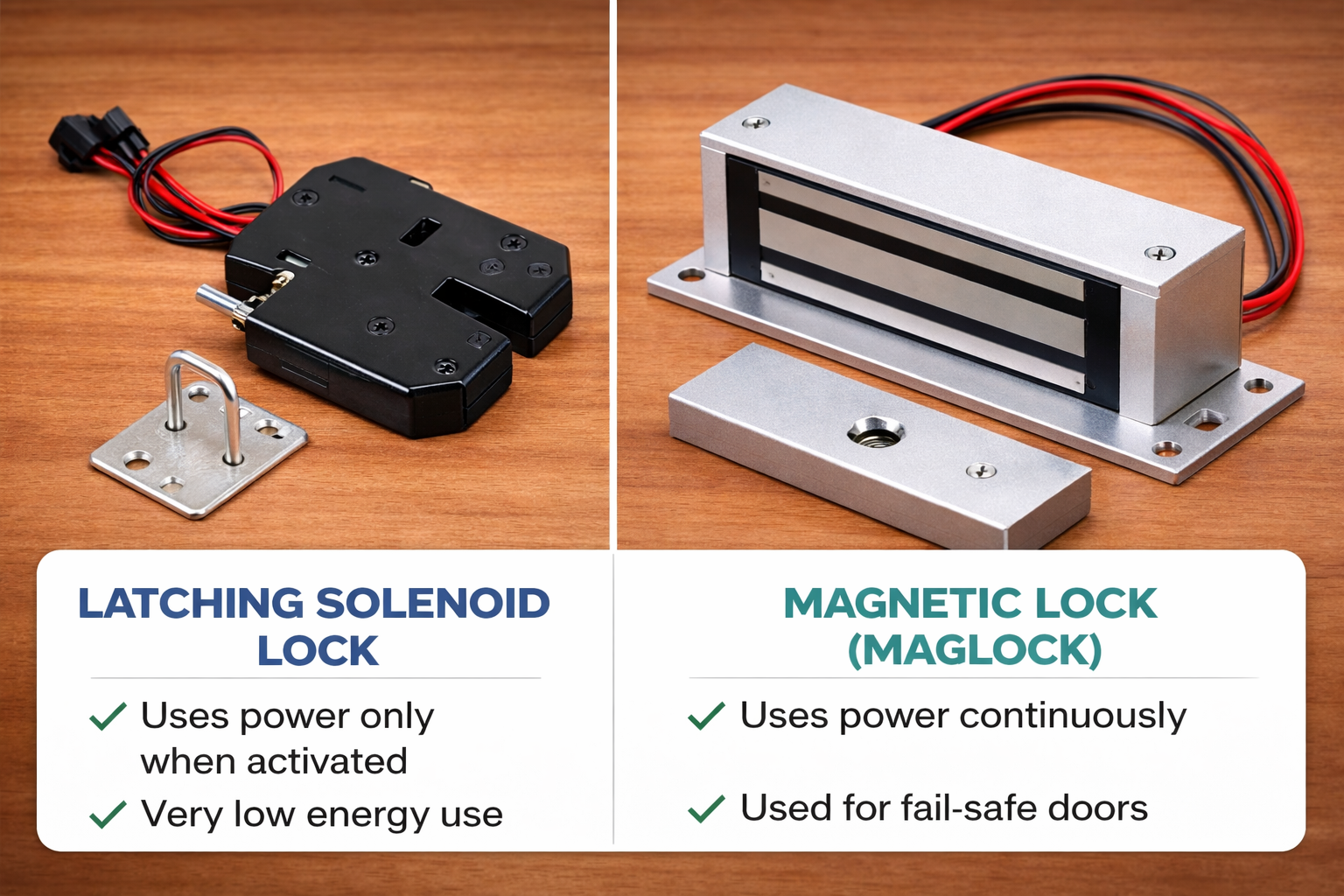
Many escape rooms rely on magnetic locks, often called maglocks.
These locks stay closed while electricity is flowing through them. When the power stops, they release. This behaviour makes them ideal for doors, because they automatically unlock if the power fails.
However, maglocks have one drawback.
They use electricity continuously while locked.
A typical 60 kg 12v maglock draws around 1.8 watts of power at all times.
At Prodigy Escapes, we schedule our rooms in two-hour game blocks, so if a maglock remains powered for the whole session, it will use:
1.8 watts × 2 hours = 3.6 watt hours of electricity
A Different Approach for Puzzle Mechanisms
For many of our puzzles we instead use latching solenoid locks.
These locks only use electricity for a brief moment when they activate. Once the latch moves, the mechanism stays open without needing any power at all.
A typical activation might use around:
12 volts × 1.5 amps × 0.2 seconds
This works out at roughly 0.001 watt hours of energy.
In most puzzles the latch only needs to release once during a game, meaning the total energy use is extremely small.
A Real Example From One of Our Rooms
To make the comparison clearer, imagine two different design approaches for the same puzzle setup during a two hour game block.
Using Magnetic Locks
If five puzzle elements were held closed using five 60 kg maglocks, the energy used would be:
5 locks × 3.6 Wh = 18 watt hours
Using Latching Locks
If those puzzles instead used two latching solenoid locks, each activating once, the energy used would be:
2 activations × 0.001 Wh = 0.002 watt hours
Comparing the Two
Maglock system during a game block:
18 watt hours
Latching system during a game block:
0.002 watt hours
That means the maglock approach would use roughly:
18 ÷ 0.002 = 9000 times more electricity
This is why we often favour latching locks for puzzle mechanisms whenever it makes sense to do so.
Built In Protection for Reliability
The latching locks we use are four wire versions which include a microswitch.
This automatically cuts power once the latch has moved. It helps prevent the solenoid from staying energised longer than needed and reduces the risk of overheating or burnout.
In environments like escape rooms where puzzles may reset thousands of times each year, this small feature helps improve both reliability and efficiency.
A Real Example Inside Wizards of Wyvern
Our fantasy themed room Wizards of Wyvern uses several latching locks across its puzzle mechanisms.
Because these locks only use electricity when they activate, their total energy consumption across thousands of games remains extremely small.
You can learn more about the room here:
Why We Still Use Maglocks on Doors
Although maglocks use more electricity, they are still the best option for escape room doors.
This is because they are fail safe. If the power ever fails, the magnet releases instantly and the door unlocks automatically so players can exit safely.
For that reason, at Prodigy Escapes, we use maglocks only where they are needed for safety, while puzzle mechanisms use more energy-efficient latching systems.
Small Engineering Decisions Add Up
Designing an escape room involves hundreds of small decisions.
Many focus on storytelling and immersion, but others are about reliability, safety, and efficiency behind the scenes.
Whenever possible, we try to design puzzles that:
• use low power electronics
• only consume electricity when something actually happens
• avoid systems that need constant power
• prioritise long term reliability
Each change on its own might be small. But across thousands of games and many years of operation, those small improvements add up.
If you would like to see how these ideas come together in practice, you can explore all of our escape rooms in Exeter.