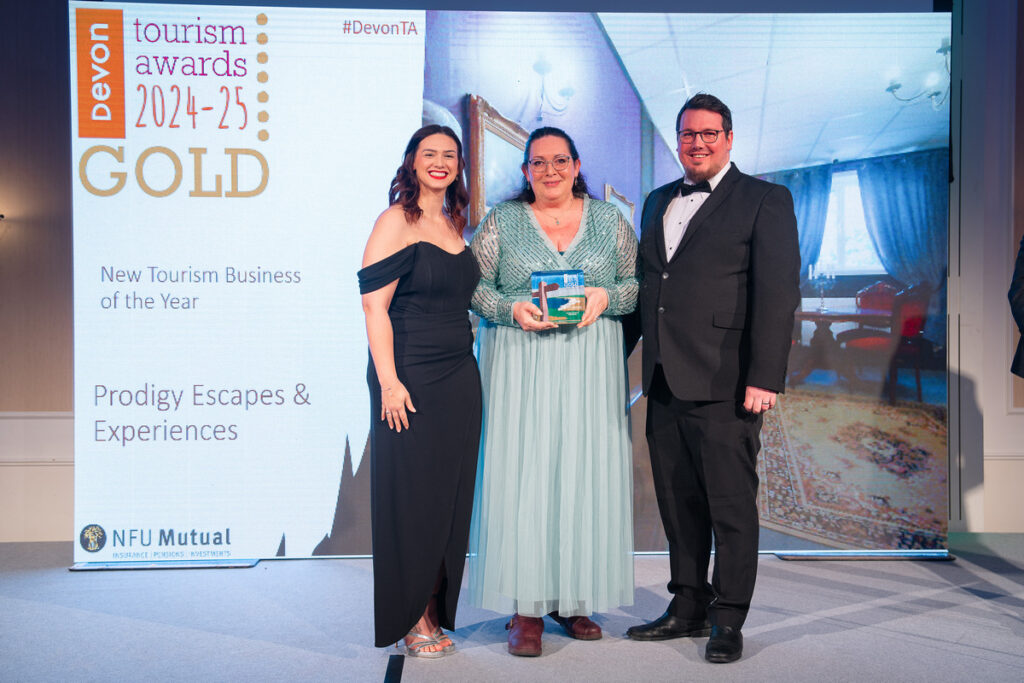
We have been fortunate to receive plenty of recognition since opening Prodigy Escapes. We have won Gold at the Devon Tourism Awards, received Best of Morty awards for two years, appeared in Escape the Review’s Top 100 and reached the finals of both the Exeter Living Awards and the UK Escape Room Awards. We have also never been nominated by TERPECA. That mixture of winning, losing, being shortlisted and being completely absent has probably been useful because it has stopped me from reaching the easy conclusion that an awards system is brilliant when it recognises us and flawed when it does not.
Instead, I have increasingly found myself wondering what an award actually tells us. That question became even more interesting this year when I stepped away from entering the Devon Tourism Awards and helped with judging instead. Seeing an awards process from the other side has made me think much more about the difference between recognising excellence and simply ranking preference.
What has actually been judged?
One of our earliest experiences was with the Exeter Living Awards. Entry was free, we submitted information about the business and on two occasions became finalists, yet on neither occasion did anybody from the awards come and experience what we actually do. That has always sat strangely with me because you can’t really understand an escape room from an application form. You can describe your customer service, set design, puzzles, story, accessibility and the atmosphere you have tried to create, but eventually somebody has to experience it.
That does not necessarily mean the judging was poor, but it does make me question what was actually being judged. Was it the quality of the application, the strength of the business, its reputation or its marketing? All of those may be legitimate things to assess, but they are not the same as experiencing the attraction itself.
That distinction became much clearer to me through the Devon Tourism Awards. Even in years when we didn’t progress, we received detailed feedback explaining where we scored well and where we could improve. When we became finalists, someone actually visited and experienced the business. We went on to win Gold for New Tourism Business and then Gold for Active and Learning Experience, and naturally those awards meant a great deal to us.
What I have come to appreciate even more, having now helped with judging, is the amount of care that goes into the process. You look at websites, communication, reviews, accessibility, the visitor journey, and the experience itself. You are not simply asking whether you personally liked a business. You are trying to assess very different attractions against a consistent set of criteria and, importantly, offer feedback that might help them improve.
That, for me, is where an award becomes genuinely valuable. Recognition is nice, but a process that can make the businesses entering it better feels much more meaningful.
Why escape room awards are difficult to judge
Escape room awards have an additional challenge because nobody can quite agree on what an escape room is supposed to be. Are they puzzle games, visitor attractions, interactive theatre, hospitality businesses or technology showcases? For most of us, they are probably a mixture of all of those things, yet some of the industry’s most influential awards eventually have to reduce that complicated experience to something much simpler: which games did experienced players enjoy most?
There is nothing inherently wrong with that. Somebody who has played hundreds of escape rooms has an extraordinary breadth of knowledge. They have seen far more puzzle structures, mechanisms and design approaches than the overwhelming majority of our customers ever will. They can recognise originality, repeated ideas and genuine innovation. That expertise has real value.
But playing hundreds of escape rooms creates one type of expertise. Running thousands of escape room games creates another.
A player might experience a puzzle once. We might watch that same puzzle being played hundreds of times. We see the intended solution, the unintended solution, the group that solves it instantly, and the team that somehow interprets it in a way nobody involved in creating the game had ever considered. Over time, that changes how you see design because you start thinking less about whether a puzzle works in theory and more about how reliably it works for wildly different people.
You refine things constantly. You add signposting, remove signposting, change wording, move an object, alter a sound cue or adjust a host instruction. Then you watch another hundred groups and discover something else you had not anticipated. Eventually, you reach the point where somebody who wasn’t involved in designing the game has to host it consistently, understand where problems can occur, and know how to recover the experience when something unexpected happens.
That operational side of escape rooms is largely invisible to the player, but it still affects quality.
The same room can produce completely different experiences
One of the biggest challenges in judging escape rooms is that the experience isn’t entirely contained within the room. Two teams can play exactly the same game on exactly the same day and leave with completely different opinions. The puzzles have not changed. The set has not changed. The host may not have changed. The people have.
There are so many variables that influence how a single playthrough feels:
- The team matters. Somebody dominating every puzzle, a teammate in a bad mood, or simply a group whose communication doesn’t click can radically alter the experience.
- The circumstances matter. Your first game after breakfast isn’t necessarily experienced the same way as the sixth game of a marathon weekend after a late night and a long journey.
- Previous experience matters. A mechanism can be astonishing the first time you encounter it. By the tenth variation, you may barely register it.
- Individual interpretation matters. One team may instinctively understand a puzzle while another becomes convinced that the solution works in an entirely different way.
- Hosting matters. Good intervention at the right moment can prevent a minor misunderstanding from becoming ten minutes of frustration.
None of those things invalidates somebody’s opinion. They do, however, make me cautious about treating a collection of individual opinions as an objective measurement.
We have seen days where one team finishes absolutely buzzing about a room and the very next group encounters friction at completely different points. Sometimes a group will adore the puzzle another team disliked. Sometimes a team leaves convinced something was unclear when hundreds of previous teams had no issue with it. Sometimes a group makes a completely reasonable interpretation that nobody had ever made before.
That variability is part of what makes escape rooms so interesting, but it also makes ranking them extraordinarily difficult.
Running games changes how you see design
Having run thousands of games, we have seen an enormous range of groups. A nine-year-old’s birthday party can be followed by a group with accessibility requirements, then experienced enthusiasts who have travelled specifically to play your rooms, then a stag do who are mainly thinking about getting back to the pub. The final booking of the day might be a workplace group where half the team did not particularly want to attend in the first place.
Your job is still to try and make every one of those experiences special.
That teaches you things about escape room design which are difficult to appreciate from a single playthrough. You learn how much flexibility a game needs. You learn that something which looked obvious during development may not be obvious at all. You learn that good signposting can be almost invisible when it works well. You learn that reliability matters as much as cleverness, and that an elegant puzzle is not much use if it works properly for only half the groups who encounter it.
You also learn how difficult it is to create something that people who weren’t involved in its creation can operate consistently. There is a huge difference between building a puzzle that works when you demonstrate it and building a puzzle that works several times a day, for years, across thousands of different players.
That perspective naturally shapes how I view awards. A game can be brilliant during one playthrough while still having weaknesses that only become apparent when you see it run repeatedly. Equally, something that might seem simple to a very experienced player may do a huge amount of work to make the game intuitive and enjoyable for a much wider audience.
Experience changes the way people play
Another complication is that many of the most influential voices in escape room awards are exceptionally experienced players.
Our games are heavily driven by story. For me, narrative is not something added around the puzzles to make the room look interesting. It is the reason the puzzles exist. A puzzle might reveal something about a character, explain an event or cause the next part of the story to unfold. We spend an unreasonable amount of time thinking about those details because we want players to feel like they are inside a story rather than simply completing a collection of tasks.
One thing we have noticed, though, is that some highly experienced groups interact with narrative material very differently from our wider audience. They can be incredibly efficient. Give them a letter, and they immediately look for the useful information. Give them a journal, and they scan for something actionable. Put several puzzles in front of them, and they instinctively divide the team and begin working in parallel.
That is not wrong. In fact, it is often a sign of an extremely capable team. But it can mean that they experience less of what we intended. Optional story material may be skipped. A joke might go unnoticed. Something designed to create a shared moment for the whole group can become three separate people completing three separate tasks.
An experienced player is therefore not necessarily a more representative player. They are simply a different kind of player.
A room designed around puzzle density and parallel solving may naturally appeal more strongly to some enthusiast groups than a room designed around shared discovery, pacing and narrative. Conversely, a family or first-time group might have exactly the opposite preference. Neither is objectively correct, but it matters when one style of play disproportionately influences which games the industry holds up as examples of excellence.
The pressure of being experienced
There is another side to this which I think operators understand particularly well. Experienced groups often arrive with expectations of themselves. If you have played 300 escape rooms, you expect to be good at escape rooms. You probably are.
That can create its own pressure.
A puzzle which causes a little friction for a first-time group may simply be part of the fun. The same puzzle can feel much more irritating to somebody who has solved hundreds of similar challenges and expects themselves to progress quickly. A few minutes of confusion can start to feel less like part of the game and more like something going wrong.
This becomes especially interesting when a team asks for no hints. I understand the appeal. Some experienced players want to know that they completed the room entirely through their own efforts. But from the Games Host’s perspective, there are moments where you know something the players do not.
Perhaps they solved the puzzle correctly, but a physical component hasn’t registered. Perhaps they have misunderstood something tiny. Perhaps they are repeating an answer that is fundamentally correct but performing one part of the interaction slightly differently. A good host does not want to rush anybody through a game, but equally we do not want to watch somebody become increasingly frustrated over something that is no longer testing their ability to solve the puzzle.
That relationship between player and host is part of the experience too, and it is another reason why reducing an escape room to a simple ranking can lose some of the complexity of what actually happened.
Visibility creates more visibility
There is also a structural issue which has nothing to do with whether individual voters are fair.
To nominate or vote for a room, somebody generally has to have played it. That sounds obvious, but it creates consequences.
A room in a major city or established escape room destination is easier for travelling enthusiasts to include in a trip. A venue surrounded by several other highly regarded games gives people even more reason to travel there. Once a room starts appearing on recommended lists, more experienced players seek it out. More experienced players visiting means more people can nominate it. More nominations create more discussion, which gives the next group more reasons to visit.
Visibility creates more visibility.
That does not mean a popular room is undeserving of its reputation. It may be absolutely exceptional. But popularity, location and accessibility inevitably become part of the mechanism that produces future popularity.
The inverse is also true. An excellent room in a less convenient location may struggle simply to get enough eligible players through the door to reach whatever nomination threshold an award requires. It may never enter the conversation in the first place.
That can create a self-reinforcing cycle where the rooms already on the enthusiast map become easier to discover, visit, and nominate. Meanwhile, another experience may need to be substantially better simply to generate enough attention to overcome the disadvantage of geography or visibility.
The resulting award can therefore tell us something subtly different from “these are the best escape rooms”. It may be more accurate to say that these are the escape rooms that enough highly experienced players have encountered and rated particularly highly.
That is still valuable information. It is simply important to understand what the information actually represents.
The things rankings struggle to see
Perhaps the part I feel most strongly about is everything surrounding the puzzles.
Some of the things that make an excellent escape room business are almost invisible when games are ranked primarily on personal enjoyment. The room has been reset correctly. The prop that failed yesterday has been repaired. The Games Host understands how to adjust their approach for the people standing in front of them. The building is clean. The toilets are clean. The booking process works. Accessibility information is accurate. The nervous player is reassured.
Then there is the challenge of making the experience work for fundamentally different groups. The family with children should receive something appropriate to them. The first-time player should not feel stupid. The group with accessibility concerns should feel that their needs have been considered. The enthusiast who has played hundreds of rooms should still receive something worth travelling for.
None of those things is particularly glamorous. They are also incredibly difficult to get right consistently.
I have played highly celebrated escape rooms containing genuinely brilliant ideas where elements of the wider visitor experience have fallen well below the standards I would personally accept within our own business. That doesn’t mean the game itself wasn’t excellent. It means the game is only one part of the attraction.
This is probably where tourism judging has changed my perspective the most. You begin looking at the whole visitor journey rather than concentrating solely on the sixty minutes spent solving puzzles. You start asking whether the experience is welcoming, accessible, reliable and professionally delivered, as well as whether the game itself is clever.
What should an award actually do?
I do not think enthusiast awards are bad for the industry. Quite the opposite. Enthusiasts have done an enormous amount to promote escape rooms, discover brilliant independent venues and encourage people to travel to parts of the country they might never otherwise have visited. Their knowledge is enormously valuable.
But perhaps we sometimes ask enthusiast awards to carry more meaning than they were ever designed to.
A ranking created by highly experienced players can tell us which games those highly experienced players particularly enjoyed. A customer review platform can tell us which experiences consistently generate strong responses from a much wider audience. A tourism award can assess things like customer service, accessibility, communication and the broader visitor journey.
Those are not competing versions of the truth. They are different lenses.
The problem only arises when we assume they are all answering exactly the same question.
Could escape room awards help raise standards?
What I have come to admire most about the Devon Tourism Awards is not the trophy. It is the process. A business can enter and discover weaknesses it did not know it had. Judges might identify missing accessibility information, unclear communication, weaknesses in the booking journey or opportunities to improve the physical experience. Even businesses that don’t win can come away better than when they entered.
I would love to see more of that philosophy within escape room recognition. Not instead of enthusiast awards, but alongside them.
Clear criteria could help. Meaningful feedback could help. Judging hospitality alongside puzzle design could help. Accessibility, hosting, reliability, storytelling, technical execution and the wider visitor journey could all form part of the conversation.
That might also help us recognise that different escape rooms are trying to achieve fundamentally different things. A phenomenal puzzle room does not need to be judged by exactly the same standards as an immersive theatrical experience. A family attraction does not need to be measured entirely against something designed for experienced enthusiasts. A small independent venue working with a modest budget may demonstrate excellence in completely different ways from a much larger attraction.
The word “best” struggles to capture all of that.
Beyond the badge
We remain completely committed to the kind of escape rooms we want to build. We believe in stories with rich narrative foundations. We want players to become the main characters in something that unfolds around them. We see puzzles as tools which can communicate those stories in different ways rather than simply obstacles placed between the team and the exit.
That will not be everybody’s preferred style of escape room, and it does not need to be. One of the great things about this industry is how broad it has become. Escape rooms can now mean elaborate theatre, complex technology, beautiful puzzle boxes, horror experiences, family adventures and countless combinations of all of them.
Perhaps recognising excellence within something that broad was always going to be difficult.
The more I have experienced awards, both as an entrant and now as a judge, the less interested I have become in the badge itself and the more interested I have become in the process behind it. Who judged it? What did they actually experience? What were they asked to consider? Who was able to participate? What does the award encourage businesses to improve?
Those questions do not diminish awards. I think they make the good ones more meaningful.
Escape rooms have grown well beyond puzzles in locked rooms. We now build games, sets, stories, technology, theatre and visitor attractions. Maybe the next stage in recognising excellence is not finding an even better way to decide which escape room is number one.
Maybe it is getting better at recognising all the different ways an escape room can be excellent.